
Dry vs. Wet Gangrene: A " Limb Vs. Life" Comparison
If you or a loved one are facing gangrene, it is important to understand that there are two very different types. Both are serious and require immediate hospital care, but the way we treat them depends on whether we are fighting starvation or infection.
To understand the difference, think of the difference between a shriveled raisin and a rotting grape.
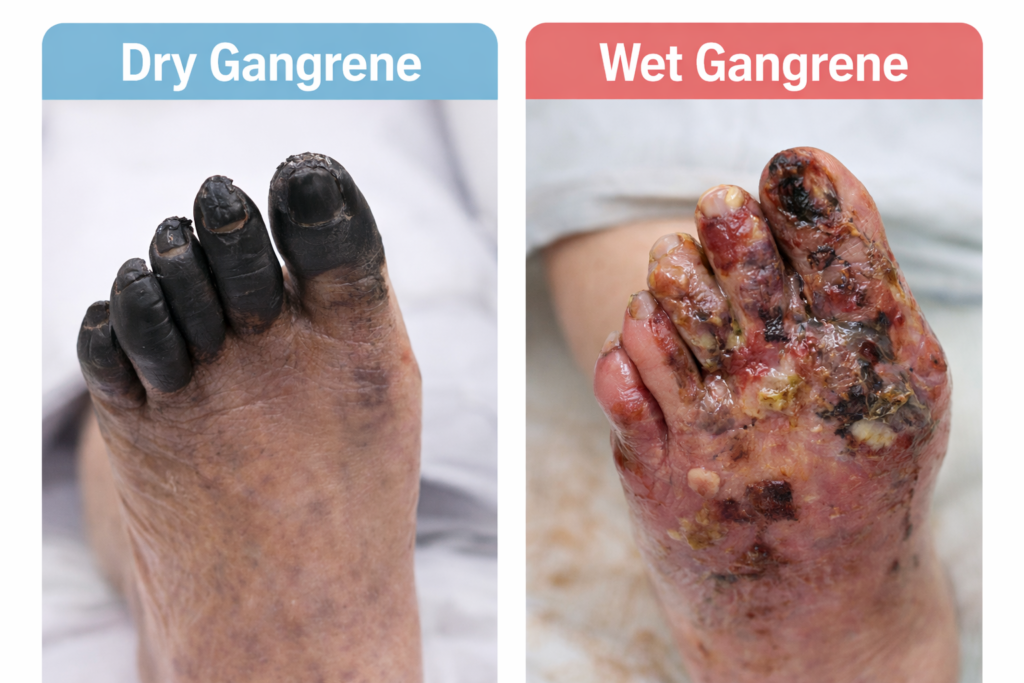
Dry Gangrene: The "Shriveled Raisin"
Dry gangrene is like a grape that has turned into a raisin. It has shriveled up because it was starved of water (in your case, blood).
- What is happening? The blood flow to your limb is completely blocked. The tissue is “starving” and eventually dies, turning dry and black.
- The Treatment Goal: Save the Limb.
The Plan: We must fix the “plumbing” first. We perform revascularization (opening the blocked pipes with stents or bypass) to bring blood back to the area. Once the blood is flowing again, we remove only the dead part (a “limited amputation”). If we cut before fixing the blood flow, the area simply won’t heal.
Wet Gangrene: The "Rotting Grape"
Wet gangrene is like a grape that has become soft, mushy, and rotten. This isn’t just a lack of blood; it is a serious bacterial infection
- What is happening? The dead tissue has become infected. This infection acts like a fire—it spreads rapidly and can enter your bloodstream, causing a life-threatening condition called sepsis.
- The Treatment Goal: Save the Life.
The Plan: We cannot wait to fix the blood flow because the infection is trying to kill the patient. We must perform an amputation first to remove the “septic focus” (the source of the rot). Once the “fire” is out and the patient is stable, we then address the underlying vascular issues.
Summary Checklist
|
Feature
|
Dry Gangrene (The Raisin)
|
Feature Dry Gangrene (The Raisin) Wet Gangrene (The Rotting Grape)
|
|---|---|---|
|
Main Problem
|
Severe blockage (Starvation)
|
Infection (Sepsis)
|
|
Appearance
|
Appearance Dry, black, shriveled
|
Swollen, oozing, "boggy"
|
|
First Priority
|
Restore blood flow (Surgery)
|
Remove infection (Amputation)
|
|
Secondary Goal
|
Save as much of the limb as possible
|
Stabilize the patient’s life
|